
Artificial Intelligence has evolved rapidly over the last few years. Large Language Models (LLMs) such as GPT, Llama, Claude, Gemini, and Mistral have transformed how businesses automate customer support, generate content, analyze documents, and build intelligent assistants.
Despite these advances, one major challenge remains: LLMs do not inherently know your organization's private data or newly published information. They generate responses based on what they learned during training, which means they can sometimes produce outdated, incomplete, or incorrect answers.
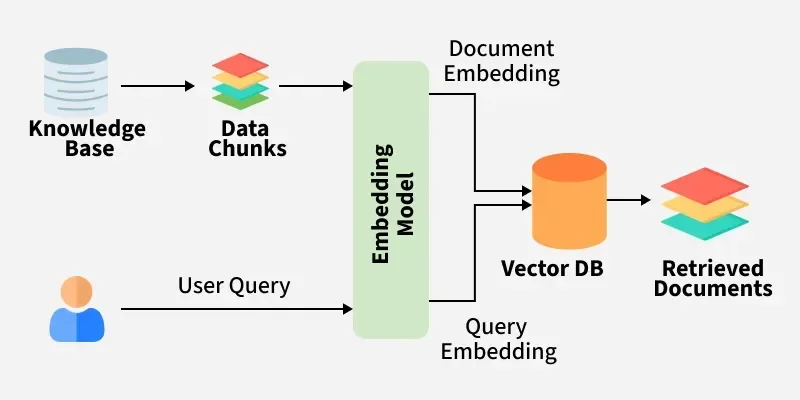
This is where Retrieval-Augmented Generation (RAG) changes the game.
Rather than relying solely on the model's built-in knowledge, a RAG system retrieves relevant information from trusted external sources—such as company documents, databases, APIs, knowledge bases, or PDFs—and provides that information to the language model before it generates a response.
The result is an AI system that is more accurate, transparent, and useful for real-world business applications.
Whether you're building an enterprise chatbot, an AI-powered search engine, a customer support assistant, or an internal knowledge platform, understanding RAG is essential in 2026.
In this comprehensive guide, we'll explore how RAG works, why it's becoming the preferred architecture for enterprise AI, and how you can implement it effectively.
Table of Contents
-
What is Retrieval-Augmented Generation (RAG)?
-
Why Traditional LLMs Need RAG
-
Understanding the Core Concept
-
Why Businesses Are Adopting RAG
-
Key Benefits of RAG
-
Real-World Business Examples
-
How RAG Differs from Traditional AI
-
Common Terminology
-
What's Next in This Guide
What is Retrieval-Augmented Generation (RAG)?
Retrieval-Augmented Generation (RAG) is an AI architecture that combines information retrieval with natural language generation.
Instead of asking an AI model to answer using only its pre-trained knowledge, a RAG system first searches a trusted knowledge source for relevant information. The retrieved content is then supplied to the language model as context before generating the final response.
Think of RAG as giving an AI assistant access to a well-organized digital library before answering a question. Instead of relying on memory alone, it can "look up" the most relevant information first.
This approach significantly improves:
-
Accuracy
-
Context awareness
-
Trustworthiness
-
Domain expertise
-
Freshness of information
For organizations that maintain large volumes of documentation, product manuals, internal policies, research papers, or customer data, RAG enables AI systems to answer questions using the latest available knowledge.
Why Traditional LLMs Need RAG
Large Language Models are trained on enormous datasets, but they have important limitations:
1. Knowledge Becomes Outdated
Once a model is trained, it doesn't automatically learn newly published information.
For example:
-
A company updates its pricing.
-
New products are launched.
-
Documentation changes.
-
Government regulations are revised.
Without RAG, the AI may continue providing outdated information.
2. Hallucinations
One of the biggest challenges with generative AI is hallucination.
A hallucination occurs when the model confidently generates information that appears correct but is actually fabricated or unsupported.
In business environments, hallucinations can lead to:
-
Incorrect customer responses
-
Compliance issues
-
Financial mistakes
-
Reduced user trust
RAG helps minimize hallucinations by grounding responses in retrieved evidence.
3. Limited Business Knowledge
An AI model has no automatic understanding of your organization's private information, such as:
-
Internal documentation
-
Employee handbooks
-
Technical manuals
-
CRM data
-
Product specifications
-
Confidential knowledge bases
RAG securely connects AI with this information without retraining the model.
4. Expensive Fine-Tuning
Fine-tuning can improve a model's performance on specialized tasks, but it often requires:
-
High-quality datasets
-
Significant compute resources
-
Time-consuming training
-
Ongoing maintenance
RAG offers a more flexible alternative by keeping the model unchanged while updating the external knowledge base whenever new information becomes available.
Understanding the Core Concept
At a high level, RAG follows four simple steps:
Step 1: A user submits a question.
Step 2: The system searches a knowledge base for the most relevant information.
Step 3: The retrieved content is combined with the user's question.
Step 4: The language model generates an answer using both the question and the retrieved context.
This workflow enables the AI to produce responses that are both conversational and grounded in trusted data.
Why Businesses Are Rapidly Adopting RAG
Organizations across industries are embracing RAG because it allows them to unlock the value of their existing knowledge without rebuilding AI models from scratch.
Common business goals include:
-
Improving customer support
-
Reducing repetitive employee queries
-
Accelerating document search
-
Enhancing compliance
-
Increasing productivity
-
Providing consistent answers
-
Delivering personalized experiences
Instead of spending hours searching through documents, employees and customers can ask questions in natural language and receive precise, context-aware responses within seconds.
Key Benefits of Retrieval-Augmented Generation
Improved Accuracy
Since responses are generated using retrieved information, answers are typically more reliable than relying solely on the model's memory.
Access to Current Information
A RAG system can retrieve recently updated content, making it suitable for fast-changing domains such as finance, healthcare, legal services, and technology.
Lower Operational Costs
Updating a document repository is significantly easier and less expensive than retraining a large language model whenever new information becomes available.
Enterprise Security
Organizations can restrict retrieval to authorized internal knowledge sources, helping protect sensitive business information while enabling employees to access what they need.
Better User Trust
When AI consistently delivers accurate, evidence-based responses, users gain confidence in the system and are more likely to adopt it.
Real-World Examples of RAG
Customer Support
A software company stores product documentation, troubleshooting guides, and FAQs in a centralized knowledge base.
When a customer asks a technical question, the AI retrieves the most relevant documentation and generates an accurate answer based on official information.
Healthcare
Medical professionals can search approved clinical guidelines and research documents, allowing AI assistants to provide responses grounded in verified medical literature instead of relying on outdated knowledge.
Financial Services
Banks can connect AI assistants to internal policy documents, loan guidelines, compliance manuals, and regulatory updates to help employees find accurate information quickly.
Legal Industry
Law firms often manage thousands of contracts, regulations, and legal precedents.
A RAG-powered assistant can retrieve relevant clauses and summarize them, significantly reducing research time while improving productivity.
Human Resources
Employees frequently ask questions about:
-
Leave policies
-
Insurance benefits
-
Payroll schedules
-
Travel reimbursement
-
Company policies
-
Onboarding procedures
Instead of manually searching HR documents, employees can simply ask an AI assistant and receive answers grounded in the organization's official documentation.
How RAG Differs from Traditional AI
| Feature | Traditional LLM | RAG-Based AI |
|---|---|---|
| Uses external knowledge | No | Yes |
| Supports updated information | Limited | Excellent |
| Hallucination risk | Higher | Lower |
| Enterprise knowledge | Limited | Strong |
| Document search | Basic | Intelligent |
| Maintenance | Model retraining | Update knowledge base |
| Scalability | Moderate | High |
Common Terms You Should Know
Before diving deeper into RAG architecture, it's helpful to understand a few foundational concepts:
-
Knowledge Base: A collection of documents, files, or data sources used for retrieval.
-
Embedding: A numerical representation of text that captures semantic meaning, allowing similar concepts to be matched even if they use different words.
-
Vector Database: A specialized database that stores embeddings and enables fast similarity searches.
-
Retriever: The component that finds the most relevant information for a user's query.
-
Generator: The language model that uses the retrieved context to produce the final answer.
-
Context Window: The amount of information an LLM can consider while generating a response.
These concepts work together to form the foundation of every modern RAG system.
What's Coming Next
Now that you've learned the fundamentals of Retrieval-Augmented Generation, the next section of this guide will dive into the complete technical architecture behind RAG.
We'll explore:
-
End-to-end RAG workflow
-
Document ingestion pipeline
-
Text chunking strategies
-
Embeddings in depth
-
Vector databases
-
Similarity search
-
Query processing
-
Prompt augmentation
-
Response generation
-
System architecture diagram
-
Best practices for building production-ready RAG systems
By the end of the next section, you'll understand how enterprise-grade RAG platforms retrieve relevant information in milliseconds and generate reliable, context-aware responses.
Written by
Web Pulses Technologies Editorial Team
Published July 1, 2026 · 5 min read