Most PHP applications do not become difficult because the language is weak. They become difficult because the codebase stops reflecting the business clearly. A team starts with a few controllers, some ORM entities, and a couple of service classes. That works for a while. Then pricing rules change, approvals become multi-step, customer states become more nuanced, and operations depend on combinations of conditions that were never modeled explicitly.
At that point, the application still runs, but the design begins to drift. Business rules get scattered between controllers, validation classes, event listeners, model accessors, and SQL conditions. Developers start asking where a rule really belongs. That is when maintainability starts to break down, and that is where domain driven design in PHP becomes useful.
Why traditional PHP structure breaks down
Many PHP projects begin with a simple structure: controllers handle requests, models map to tables, and service classes fill gaps when logic starts to grow. That structure is fast to start with, but it assumes the database schema is the same thing as the business model. In real applications, that is rarely true.
The business may care about rules such as whether an order can be confirmed, whether a refund is allowed, whether stock can be reserved, or whether a subscription can renew after a failed payment. These are behavioral rules, not just data storage concerns. If they are spread across many layers, the system becomes fragile and expensive to change.
What Domain-Driven Design changes
DDD organizes code around business language and business behavior rather than around framework defaults. In practical PHP terms, that means the code starts modeling concepts such as Order, Invoice, Subscription, Money, DateRange, or EmailAddress in a way that reflects real business rules.
The point is not to add complexity for its own sake. The point is to make important rules obvious, protect consistency, and make large systems easier to evolve over time. Three of the most useful building blocks for that are value objects, aggregates, and repositories.
Value objects: protecting meaning and validity
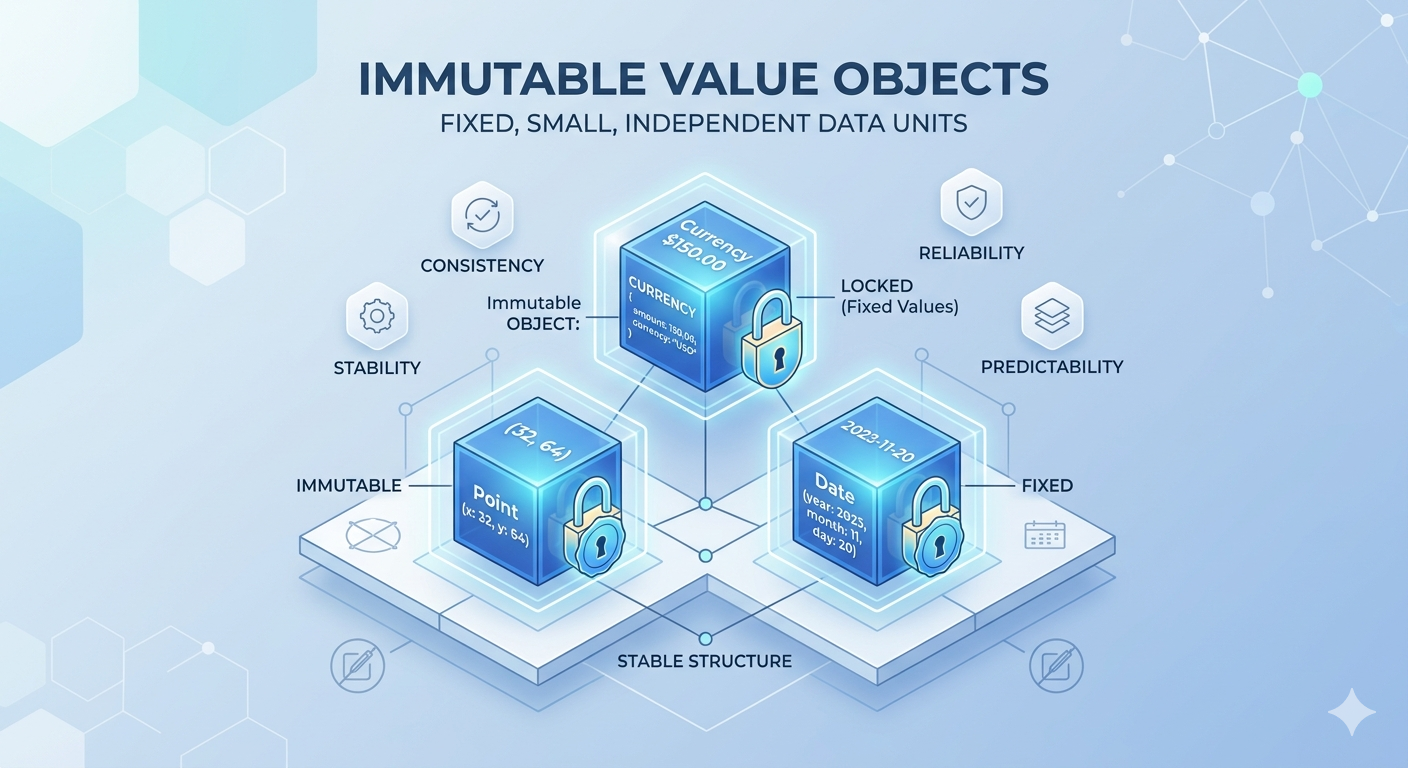
A value object is defined by what it means, not by a unique identity. Money, EmailAddress, DiscountPercentage, BillingCycle, and ShippingAddress are common examples. In PHP, value objects work best when they are immutable and always valid once created.
This changes the burden of validation. Instead of validating raw strings and numbers everywhere, the domain can trust the type. If an EmailAddress object exists, the rest of the system can rely on it being normalized and valid. If a Money object exists, the domain can compare, add, and subtract amounts safely without leaking rounding and currency rules across the codebase.
Value objects are often the easiest place to begin because they remove repeated defensive code quickly. They also improve readability. A method that accepts Money or DateRange communicates far more than one that accepts a float or a pair of strings.
Aggregates: protecting consistency boundaries
An aggregate is a cluster of related domain objects treated as a single consistency boundary. The aggregate root is the entry point through which state changes happen. It is responsible for protecting invariants that must always remain true together.
Take an Order aggregate as an example. The business may require that an order cannot be confirmed unless it has at least one item, a valid customer, and a non-negative total. If line items, totals, and status changes are updated independently across different services, invalid states become easy to create. The aggregate root prevents that by exposing explicit behaviors such as addItem(), applyDiscount(), confirm(), or cancel().
A good aggregate is not a massive object that owns everything remotely related to a concept. It is a carefully chosen boundary around rules that must stay consistent in the same transaction. That distinction matters for performance, scalability, and clarity.
Repositories: keeping persistence out of business decisions
A repository gives the application layer a collection-like interface for working with aggregates. In DDD, a repository is not just an extra wrapper around an ORM. Its job is to load and persist aggregate roots without forcing domain behavior to depend directly on query builders or table structure.
For example, a SubscriptionRepository might expose methods such as findById(), findActiveForCustomer(), and save(). The application service uses the repository to obtain the aggregate, call domain methods, and store the result. That keeps persistence mechanics separate from business decisions.
Repositories should stay focused. They should serve domain behavior around aggregates, while reporting queries, analytics views, and dashboard filters can live in separate query services. This keeps the abstraction useful instead of bloated.
How these three patterns work together
The real benefit appears when aggregates, repositories, and value objects work as one design. Imagine a subscription billing system. The Subscription aggregate owns renewal rules, pause rules, cancellation rules, and allowed status transitions. It uses value objects such as Money, BillingCycle, RenewalDate, and CustomerEmail. The SubscriptionRepository retrieves and saves the aggregate for the application layer.
When a renewal command arrives, the application service loads the subscription, calls renew(), and saves it. The domain method checks whether the subscription is active, whether the billing window is valid, whether the amount is acceptable, and whether the next renewal date can be calculated. The business rule has one clear home.
Common mistakes when adopting DDD in PHP
The first mistake is overengineering simple CRUD features. Not every admin table needs rich domain modeling. Apply DDD where business complexity is real or clearly growing. The second mistake is creating generic repositories filled with unrelated query methods. That leads right back to confusion. The third mistake is treating aggregates like large object graphs instead of clear consistency boundaries.
Another common problem is leaving framework models in charge of everything and then layering DDD terminology on top without changing the behavior. If the real rules still live in controllers and listeners, the architecture has not actually improved.
Where to start in an existing codebase
The safest way to introduce DDD in PHP is to start with one painful domain area. Look for repeated validation, scattered status rules, or workflows that break whenever features change. Those are strong candidates.
Create a few high-value value objects first. Then move one important workflow into an aggregate root with clear methods. Add a repository that supports aggregate loading and persistence. Over time, the model becomes more expressive, the domain language becomes clearer, and the cost of change goes down.
If you are also evaluating architectural direction for modern PHP products, it can help to compare domain modeling decisions with broader backend tradeoffs in Laravel vs Node.js in 2026. For teams building service-heavy platforms, related architecture patterns in API development services and microservices architecture services are also useful next reads.
Final takeaway
Domain driven design in PHP is not mainly about patterns. It is about making the business visible and enforceable in code. Value objects protect meaning. Aggregates protect consistency. Repositories protect boundaries. Used together, they help PHP teams move from framework-shaped applications to business-shaped systems.
That shift is what keeps a codebase understandable as it grows. Instead of scattering rules across technical layers, you model the domain directly. The result is cleaner behavior, fewer fragile dependencies, and a system that stays maintainable for much longer.
Written by
Web Pulses Technologies Editorial Team
Published April 15, 2026 · 5 min read